0 artículo(s)
Ver cesta
No tiene artículos en su carrito de compras.



You're standing over a 2-inch monitoring well at a former dry cleaner site. The work order says vapor sampling. You need to pull a representative air sample from the well headspace without breaking the seal, without removing the cap, and without compromising the data integrity your lab and your regulator both demand. Two products do exactly this — the J-Plug Xcap and the Torquer by Koby Environmental. Both are American-made vapor extraction well plugs. Both lock. Both seal. But they take different approaches to the same problem, and the one you pick depends on what matters most on your site.
Standard monitoring well caps were never designed for vapor work. They sit on top of the casing, they don't seal airtight, and pulling one off to sample means exposing the well headspace to ambient air — which contaminates your reading before you even connect the tubing. A vapor extraction well plug replaces that standard cap with an expansion plug that seals inside the casing and includes a built-in port for drawing vapor samples directly through the plug. The cap stays locked in the well. Your sample stays representative. Your chain of custody stays clean.
This matters more now than it did a decade ago. The EPA's 2015 Technical Guide for Assessing and Mitigating the Vapor Intrusion Pathway tightened expectations around how consultants collect and document subsurface vapor data. The agency's own Vapor Intrusion Database includes 2,929 paired measurements from 42 sites nationwide — and 85% of those involve residential buildings, where the stakes for accurate data are highest. With an estimated 450,000 or more brownfield sites across the U.S. (per Government Accountability Office reporting), the volume of vapor monitoring work isn't shrinking. Reliable, tamper-resistant well hardware is part of doing that work right.
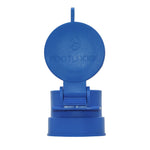
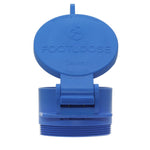
The J-Plug Xcap is a locking expansion plug built from reinforced chemical-resistant nylon — no metal in the structural body, so nothing corrodes in the field. It seats inside the well casing using two separate Buna-N o-rings plus a wide rubber seal, which gives it an increased gripping area and a genuinely watertight fit. The large wing nut expands the plug against the casing wall, and a flip-down locking hasp accepts a padlock for tamper security.
What makes it an Xcap rather than a standard J-Plug is the airtight brass valve integrated into the top of the plug. This valve connects to a quick-connect extraction coupling — you attach your sampling line, the valve opens, and you draw vapor or water directly from the well headspace. When you disconnect, the valve closes and the dust cover flips back over the port. You never remove the plug from the well. You never break the seal.
The brass valve is the defining feature here. It provides a positive shutoff between sampling events, which means the well stays sealed even if someone bumps the plug or the site gets foot traffic between rounds. For landfill gas sampling, where you're dealing with methane and volatile organic compounds in concentrations that matter, that continuous seal is a real advantage.
Available sizes: 2" and 4" in SCH 40 and SCH 80 configurations.
If you've spent time on environmental jobsites, you've probably already handled a Torquer. Koby Environmental has been manufacturing these since 1989, and they've become something close to an industry default — the plug that gets specified by name on work orders and purchase requisitions. There's a reason for that, and it starts with how fast they go in and come out.
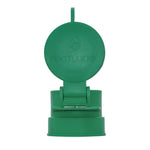
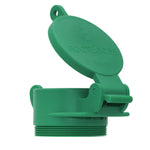
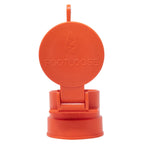
The Torquer is manufactured from an engineering-grade polymer blend — the same class of material used to replace steel gears in industrial applications. No metal parts anywhere. It uses a high-tech liquid-tight seamless dual rubber gasket (not o-rings — a single continuous gasket) and seats with a smooth-acting wing nut that requires no tools. Hand-tighten, lock, walk away. The domed top prevents liquid pooling, which matters in flush-mount installations where surface water collects.
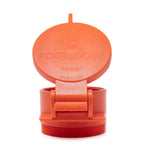
For vapor work, the Torquer uses a vented port with a self-sealing cap. It can be converted for use with vapor extraction fittings, pressure gauges, vacuum gauges, or threaded line fittings. The plug also accepts #1 or #3 type padlocks or safety lock-out tags for regulatory compliance. And it disassembles completely in the field for decontamination — no trapped spaces where cross-contamination can hide between wells.
Techs who run 15 wells in a day care about three things: speed of installation, reliability of the seal, and ease of decon between locations. The Torquer nails all three. The flush OD design means you can lasso around the wing nut and lower the plug into the well using a winch or cat lines during installation or abandonment — a detail that matters more than it sounds like it should when you're working deep sets.
Available sizes: 1", 1.25", 1.5", 2", 3", 3.5", 4", 4.5", and 6" — SCH 40 and SCH 80 options across the range. The Torquer covers virtually every standard monitoring well casing you'll encounter.
| Feature | J-Plug Xcap | Torquer (Koby Environmental) |
|---|---|---|
| Body Material | Reinforced chemical-resistant nylon | Engineering-grade polymer blend (gear-grade) |
| Sealing Mechanism | Dual Buna-N o-rings + wide rubber seal | Seamless dual rubber gasket (continuous) |
| Vapor Extraction Method | Airtight brass valve with quick-connect coupling | Vented port with self-sealing cap; convertible to extraction fittings |
| Tool Requirements | Wing nut (hand-tightened) | Wing nut (hand-tightened, no tools needed) |
| Locking Mechanism | Flip-down hasp, accepts padlock | Accepts #1 or #3 padlocks or lock-out tags |
| Casing Sizes | 2", 4" (SCH 40 & SCH 80) | 1" through 6" (SCH 40 & SCH 80) |
| Field Decontamination | Dust cover protects valve port | Fully disassembles in field for complete decon |
| Liquid Pooling Prevention | Standard top profile | Domed top sheds water |
| Metal Components | Brass valve and quick-connect fitting | None — entirely non-metallic |
| Best For | Dedicated vapor monitoring stations, landfill gas | High-volume site work, multi-well programs |
Your primary concern is a continuously sealed vapor extraction point. The integrated brass valve means the well stays airtight between sampling events with no exposed ports — the dust cover adds a second layer of protection. This makes the Xcap the stronger choice for dedicated vapor monitoring stations where the plug stays installed long-term and data integrity over months or years is the priority. Landfill gas monitoring, long-term subslab correlation studies, and sites where you need to demonstrate an unbroken seal to a regulator all favor the Xcap design.
The trade-off is size range. With only 2" and 4" options, the Xcap doesn't cover the oddball casings — 1.25" piezometers, 3" wells, or 6" extraction wells. If your site has mixed casing sizes, you may end up running two different plug platforms.
You're running a multi-well monitoring program and need a vapor extraction well plug that covers every casing diameter on the site. The Torquer's size range — 1" through 6" — means one product line handles the whole network. The tool-free installation, full field disassembly for decon, and domed top for flush-mount applications make it the go-to choice for environmental consulting firms managing dozens or hundreds of wells across multiple sites.
The Torquer's vapor extraction port works through a convertible vented fitting rather than an integrated valve. That means there's a brief moment during connection when the port is open to atmosphere. For most vapor monitoring applications, this is not a data quality issue — you purge the line before sampling anyway. But for applications demanding a provably continuous seal (regulatory demonstration, legal defense sampling), the Xcap's valve-based design has a technical edge.
Plenty of consultants do. Xcaps on the dedicated vapor monitoring points that feed into regulatory reporting. Torquers on everything else — water-level wells, piezometers, extraction wells, and any casing size the Xcap doesn't cover. EDP stocks both product lines for exactly this reason.
None of this is academic. The EPA's vapor intrusion framework requires that site assessments evaluate the migration of volatile chemicals from soil and groundwater into indoor air. At Superfund sites alone, a 2010 GAO report found that 60 out of 164 reviewed sites may pose risks specifically because of vapor intrusion. CERCLA Section 121 mandates five-year reviews at sites where contamination remains — and those reviews increasingly scrutinize whether monitoring hardware maintains the data quality the remedy depends on.
A vapor extraction well plug that doesn't seal properly doesn't just give you a bad number. It gives you a defensible-looking bad number — one that could underpin a no-further-action decision or a risk assessment that understates actual exposure. The hardware matters.
Both the J-Plug Xcap and Torquer vapor extraction plugs are available through EDP. We stock both in SCH 40 and SCH 80 configurations. If you're not sure which casing schedule your wells use, your well installation logs will specify — or measure the wall thickness and we can help you match.
For most environmental consulting firms, the Torquer is the volume workhorse and the Xcap is the precision instrument. Neither product is wrong. The right answer depends on your wells, your regulatory program, and how many sites your techs are hitting this week.
Questions about sizing, compatibility, or bulk orders? Contact us directly — we'll get you an answer, not a sales pitch.