0 artículo(s)
Ver cesta
No tiene artículos en su carrito de compras.



Your well cap has a small screened opening on top. Or it doesn't. That's not random — there's a reason for each design, and picking wrong can cause real problems.
We see it all the time: a homeowner notices bugs near their wellhead, spots a screened vent on the cap, and decides to seal it up with caulk or tape. Problem solved, right? Not even close. That vent exists for a reason, and plugging it can damage your pump, pull contaminants into your water supply, or both. Understanding the difference between a vented vs non-vented well cap starts with understanding what's happening inside your well casing every time the pump kicks on.
When your submersible pump turns on, it pushes water up and out of the casing. That water has to be replaced by something — air. Without a path for air to enter the casing, the pump creates a partial vacuum. That vacuum works against your pump, forcing it to labor harder, cycle more frequently, and wear out faster.
This is vacuum lock. It's not dramatic — your faucet doesn't suddenly stop. Instead, you get reduced flow, pressure fluctuations, and a pump that short-cycles. Over months, that shortens equipment life significantly.
A vented cap prevents this by letting air flow in and out freely as the water level rises and falls. It's pressure equalization, plain and simple.
Most residential water wells in the United States use vented caps. Here's why:
Pressure equalization during pump cycling. Every time your pump runs, the water level inside the casing drops. Air needs to fill that space. When the pump shuts off, the water level recovers and pushes air back out. A screened vent handles this exchange without letting anything harmful in.
Gas venting. Some wells produce methane, hydrogen sulfide, or radon gas — naturally occurring gases that can accumulate in the air space above the water line. A vented cap lets these gases dissipate rather than building up to dangerous concentrations. In areas with known methane presence in groundwater, venting isn't optional. It's a safety requirement.
Water table fluctuation. If your water table shifts seasonally — and most do — the air volume inside the casing changes constantly. A sealed cap turns your casing into a pressure vessel it was never designed to be.
Code requirements. Many state well construction codes require vented, vermin-proof caps on all new wells. Minnesota, California, and Michigan are among the states with explicit requirements. The standard is a sanitary well cap: watertight against rain and surface water, but vented through a screened opening for air exchange.
Not every well should breathe. Some absolutely must not.
Artesian wells. If your well is under natural pressure — water rises above the static level or flows at the surface without pumping — a vented cap would let that pressure escape. Artesian wells require sealed, pressure-rated caps or flanged assemblies that contain the upward force. In many jurisdictions, controlling a flowing artesian well is legally required to prevent waste of the aquifer resource.
Pressurized systems. Some well designs use pressurized casings as part of the delivery system. These need a fully sealed cap rated for the expected internal pressure.
Flood-prone or contamination-prone locations. Wells in areas subject to regular flooding, chemical runoff, or surface contamination sometimes use sealed caps as an additional barrier — though this requires an alternative venting arrangement or a system designed to operate without atmospheric equalization.
Here's the key distinction: choosing between a vented vs non-vented well cap isn't about preference. It's dictated by your well's physical conditions and your local code.
A vented cap without an intact screen is worse than no vent at all. It's an open invitation to every insect, spider, and earwig in the neighborhood.
Michigan's Department of Environment, Great Lakes, and Energy (EGLE) has documented this extensively: insects enter wells through gaps in older caps or damaged screens, build nests inside the casing, and die in the water supply. Decomposing insects introduce organic matter that feeds bacterial growth. If insects have been found in a well that tests positive for coliform bacteria, EGLE considers them the likely contamination source.
The numbers back this up. According to the EPA, more than 23 million U.S. households rely on private wells, and a USGS study of 2,100 wells found that one in five had at least one contaminant exceeding health-based benchmarks. A Maryland study found that 25.4% of tested private wells had total coliform bacteria. Forty percent of well owners have never tested their water at all.
Screen specifications matter. Most well codes require at minimum a #24 mesh screen (24 openings per inch), which blocks flies and larger insects. California requires #16 mesh or finer on all vermin-proof caps. The screen must be corrosion-resistant — stainless steel or bronze, not the hardware-cloth patch jobs we've seen in the field.
Inspect your vent screens at least twice a year, spring and fall. Look for wasp nests, spider webs, corrosion holes, or debris blocking airflow. A clogged screen creates the same vacuum problem as a sealed cap.
Here's a quick field check:
If you're not sure, ask your well driller. They can tell you in about ten seconds.
We mentioned it up top, but it bears saying again because we hear about it regularly: do not seal a vented well cap.
If you're seeing insects near your wellhead, the answer isn't to plug the vent. The answer is to replace or repair the screen. If insects are getting past the screen, the screen is damaged. If they're getting in around the cap gasket, the gasket needs replacement or the cap doesn't fit the casing properly.
Sealing the vent on a standard residential well creates a cascade of problems: vacuum lock during pumping, potential gas accumulation, moisture buildup that accelerates corrosion inside the casing, and — ironically — pressure differentials that can actually pull contaminated surface water in through the annular seal at the base.
Fix the screen. Don't kill the vent.
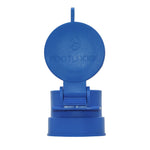
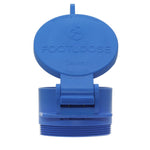
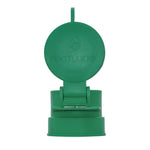
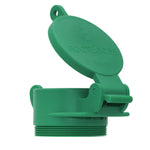
EDP's Grip-N-Lock well caps are designed primarily for monitoring wells, where the venting question comes up constantly. Monitoring wells often need vapor extraction or pressure relief — you're literally trying to sample what's in the air column inside the casing.
The Grip-N-Lock line includes vapor monitoring well plugs that provide controlled venting for exactly this purpose. The cap's ten internal concentric rings create a tamper-resistant compression seal on SCH 40 to SCH 80 PVC, while dedicated vapor extraction models allow gases to escape safely. No padlocks, no bolts, no glue — the cap taps on and locks mechanically.
For applications requiring a fully sealed cap, the standard Grip-N-Lock provides a watertight compression seal without a vent. The choice between vented and sealed versions comes down to the same question as any vented vs non-vented well cap decision: what does this specific well need?
Here's the decision in plain terms:
When you're weighing a vented vs non-vented well cap, the well itself tells you the answer. Pressurized wells get sealed. Everything else gets vented — with a good screen.
Browse our full selection of well caps to find the right fit for your casing size and application, or call us at 866-514-3684 if you're not sure what your well needs. We'll help you figure it out.